🌡️Loading conditions… 💨Wind — 🌊Surf — 🌊Tide — 🌅— 🌙— 🕐--:--

🔍 Sammy Quick Search — businesses & events
🎙️ Listening…

Breaking
◆Loading today's Palm Coast news…
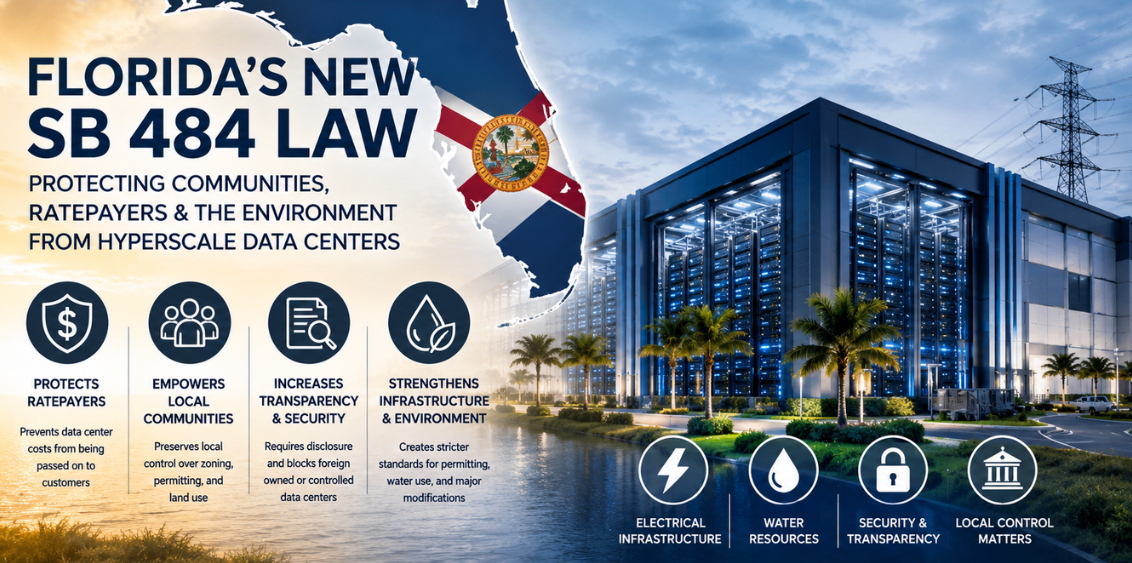
On May 7, 2026, Ron DeSantis signed Senate Bill 484 into law in Lakeland. The legislation focuses on protecting ratepayers, preserving local government authority, increasing transparency, and addressing environmental concerns tied to large-scale data center projects.
The law comes at a time when states across the country are seeing explosive growth in artificial intelligence infrastructure, cloud computing facilities, and large-scale digital storage operations.
For many Florida residents, SB 484 may become one of the most important laws shaping future conversations about development, utilities, water resources, and local control.
Hyperscale data centers are extremely large facilities designed to process, store, and distribute massive amounts of digital information.
These facilities support:
Unlike smaller server facilities, hyperscale data centers often require:
As demand for AI and cloud services grows, more communities across the United States are debating how these facilities should be regulated.
The new law creates additional protections and rules surrounding hyperscale data center development in Florida.
According to the state, the legislation is designed to:
The law also establishes clearer legal definitions for hyperscale data centers and creates a more structured permitting process.
One of the most significant parts of SB 484 is that it preserves local government authority over data center approvals.
Under the law:
That provision is important because many states have recently faced criticism for limiting local control over major industrial or infrastructure projects.
Florida’s new law moves in the opposite direction by reinforcing community decision-making power.
For residents concerned about rapid development, infrastructure strain, or environmental impacts, this may become one of the most closely watched parts of the legislation.
Another major focus of SB 484 involves electricity and utility costs.
Large-scale data centers can consume enormous amounts of power, and some states have faced criticism after utility infrastructure costs were indirectly passed onto residential customers.
Florida’s new law prohibits utilities from shifting data center-related costs onto:
Instead, hyperscale operators are expected to cover the full cost of service tied to their facilities.
Supporters argue this helps protect homeowners and smaller businesses from subsidizing major industrial projects through higher utility bills.
As hyperscale facilities expand nationwide, water consumption has become a growing issue.
Large data centers often require extensive cooling systems, particularly in warm climates like Florida.
SB 484 addresses this by:
Environmental concerns surrounding data centers have increasingly focused on:
Florida lawmakers say the new law helps protect natural resources while still allowing responsible development.
Even residents who never think about data centers could eventually feel their impact.
Large-scale facilities can influence:
As artificial intelligence and cloud computing continue expanding, many communities are beginning to realize that digital infrastructure still requires significant physical infrastructure behind the scenes.
SB 484 reflects growing concerns nationwide about how communities balance technology growth with environmental protection and local oversight.
Florida has already seen growing conversations surrounding:
Some communities view data centers as economic opportunities.
Others worry about:
SB 484 suggests Florida lawmakers expect these debates to continue growing in the years ahead.
Read How Florida’s New HB 927 Law Could Speed Up Permits and Development Across Local Communities:
Palm Coast Local HB 927 Article
SB 484 is a new Florida law signed in May 2026 that regulates hyperscale data centers and adds protections involving utilities, environmental concerns, and local government authority.
A hyperscale data center is a very large facility used to support cloud computing, artificial intelligence, streaming platforms, and massive digital storage operations.
Yes. The law specifically preserves local zoning and permitting authority, allowing cities and counties to deny projects or establish stricter standards.
According to the law, utilities cannot pass hyperscale data center costs onto residential or small business customers.
Large data centers often require extensive cooling systems that can consume significant amounts of water, especially in warmer climates.
Potentially. Hyperscale data centers can use enormous amounts of electricity, which may require additional grid infrastructure and power generation capacity.
No. The law does not ban data centers. It creates regulations and protections surrounding how they are approved, permitted, and serviced.
AI systems require massive computing power and storage capacity, increasing demand for hyperscale infrastructure nationwide.
Yes. Large facilities can influence industrial zoning, infrastructure expansion, utility planning, and surrounding land development.
Reclaimed water is treated wastewater reused for non-drinking purposes such as cooling systems or irrigation. The law allows reclaimed water to be considered during permitting processes.
Source: Florida SB 484 Press Release Newsroom by Governor Ron DeSantis
Add comment