Updated November 6, 2026 | Florida Property Taxes
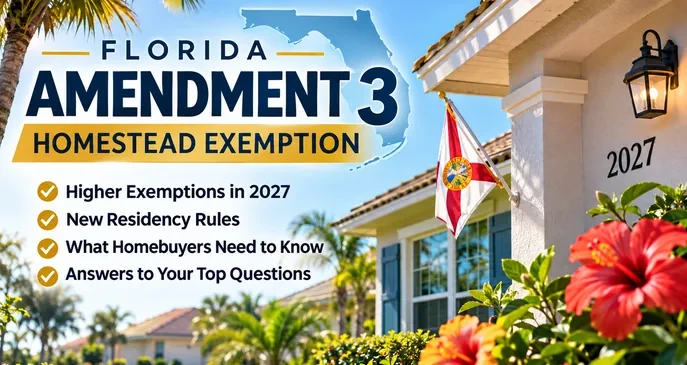
Florida Amendment 3: New Homestead Exemption Rules, Residency Deadlines and What Homebuyers Need to Know
Florida voters approved Amendment 3 on November 3, 2026, expanding the state's existing Homestead Exemption and introducing new rules that begin January 1, 2027.
According to the Florida Department of State election results, the amendment received approximately 61.98% voter approval, exceeding the 60% threshold required for constitutional amendments.
First, an important clarification: Amendment 3 does not establish an entirely new Homestead Exemption program. It modifies and expands Florida's existing constitutional Homestead Exemption, which has protected qualifying primary residences for decades.
The increased exemption applies to non-school property taxes. It does not eliminate all property taxes or replace Florida's existing homestead protections.
Understanding Florida's Existing Homestead Exemption
Florida's Homestead Exemption is established under Article VII, Section 6 of the Florida Constitution.
It allows qualifying permanent Florida residents who own their primary residence to reduce the assessed value of their property that is subject to taxation.
Under the rules in effect for the 2026 tax year, qualifying homeowners may receive a combined exemption of up to $51,411.
This consists of an initial $25,000 exemption applicable to property taxes, including school taxes, and an additional $26,411 exemption applicable to non-school property taxes.
The additional amount reflects previously authorized inflation adjustments.
The exemption reduces a property's taxable assessed value. It does not reduce the home's actual market value or provide a direct cash payment to the homeowner.
What Amendment 3 Changes Beginning in 2027
The amendment significantly increases the exemption available for non-school property taxes for qualifying homeowners.
$51,411 Maximum combined exemption in 2026
$150,000 Non-school exemption beginning in 2027
$250,000 Non-school exemption beginning in 2028
The $150,000 and $250,000 amounts represent the total expanded exemptions for non-school taxes. They are not additional amounts stacked on top of the previous exemption.
Beginning in 2029, the larger exemption is subject to annual inflation adjustments.
What homeowners should remember: The existing $25,000 school-tax exemption remains in place. School district property taxes and applicable non-ad valorem assessments may still be owed.
Who Qualifies for the Larger Exemption?
Amendment 3 introduces an important distinction between existing Florida residents and people who become Florida residents after 2026.
Florida Residents by December 31, 2026
Homeowners who were permanent Florida residents by December 31, 2026, may qualify for the expanded exemption once they meet the requirements for a Florida homestead.
Importantly, these individuals do not necessarily have to own a home by December 31, 2026.
A Florida resident who is currently renting may purchase a home later and qualify for the expanded exemption once the property becomes an eligible homestead.
People Becoming Florida Residents in 2027 or Later
People who first become Florida residents after December 31, 2026, initially receive the existing Homestead Exemption available under the amendment.
Under the new provisions, the expanded exemption begins in the fifth year of qualifying Homestead Exemption eligibility.
These new-resident provisions apply only to the extent permitted by the U.S. Constitution. Additional state implementing guidance may clarify their administration.
Two dates, two different requirements:
December 31, 2026 determines which residency provision applies under Amendment 3.
January 1 remains the annual date used to determine ownership and permanent-residence eligibility for a property's Homestead Exemption.
Buying property and establishing permanent Florida residency are not automatically the same thing.
Will Amendment 3 Eliminate Property Taxes?
No. The amendment expands tax exemptions but does not eliminate every property tax or assessment.
Homeowners may continue to owe school district property taxes and non-ad valorem assessments, including certain charges for solid waste, stormwater management and other services.
Actual savings depend on assessed value, eligibility and local property tax rates.
An Example of How the New Exemption Works
Consider an eligible homeowner with a property assessed at $200,000.
In 2027: The expanded $150,000 non-school exemption could leave $50,000 subject to non-school property taxes.
In 2028: A $250,000 exemption could eliminate the taxable assessed value for non-school taxes on that property, assuming its assessed value remains at $200,000.
School district taxes and applicable non-ad valorem assessments would remain.
This example is for illustration only and does not represent a guaranteed tax bill or specific savings amount.
What Happens to Save Our Homes?
Florida's existing Save Our Homes assessment limitation remains in effect.
This protection generally limits annual increases in a qualifying homestead's assessed value to 3% or inflation, whichever is lower.
Florida's existing portability rules also remain in place. Eligible homeowners may still transfer certain Save Our Homes assessment benefits when moving to another qualifying Florida homestead.
Amendment 3 does not eliminate existing additional exemptions for qualifying seniors, veterans, widows, widowers or persons with disabilities.
What About Rental Properties, Second Homes and Businesses?
The amendment also changes the annual assessment-increase limitation for many qualifying non-homestead properties.
Beginning in 2027, the assessment cap for non-school property taxes decreases from 10% to 5%.
This can affect rental homes, vacation properties, commercial real estate and other qualifying non-homestead properties.
The change limits certain annual increases in assessed value but does not guarantee a reduction in the final property tax bill.
How Will Amendment 3 Affect Local Governments?
The amendment also introduces rules governing the use of county and municipal property tax revenues.
Specified spending categories include public safety, education and schools, infrastructure, natural resources, bond debt service, employee retirement benefits, and government operations and administration.
Other expenditures may be approved by authorized county officers or governing bodies unless prohibited by state law.
The amendment also requires the Legislature to establish a procedure through which counties and municipalities may further increase homestead exemptions for their respective tax levies.
Such additional exemptions are not automatic and will depend on the applicable legal and administrative procedures.
Floridians Most Asked Questions About Amendment Three
For existing homeowners, first-time buyers, people relocating to Florida and residents preparing to close on a property, the following questions address some of the most important situations.
1. I'm closing on my Florida home before December 31, 2026. Will I qualify for the increased exemption?
Potentially, yes. You must establish permanent Florida residency by December 31, 2026, and generally own and occupy the property as your qualifying permanent residence on January 1, 2027.
Closing on the property alone does not automatically establish permanent Florida residency.
2. I already live in Florida but rent. If I buy a home in 2027, must I wait five years?
Generally, no. If you established permanent Florida residency by December 31, 2026, you may qualify for the expanded exemption when you later purchase and establish an eligible homestead.
The December 31 residency cutoff does not require existing Florida residents to own property by that date.
3. I'm under contract, but my closing is in January 2027. What happens?
If you do not own the property on January 1, 2027, you generally cannot claim its Homestead Exemption for the 2027 tax year.
Your first qualifying tax year would ordinarily be 2028, provided you meet the ownership and permanent-residence requirements by January 1, 2028.
If you were already a permanent Florida resident by December 31, 2026, a later closing would not, by itself, place you under the new-resident waiting provision.
4. I'm moving from another state in 2027. Will I immediately receive the full $150,000 exemption?
Generally, no. A person who first becomes a Florida resident after December 31, 2026, falls under the new-resident provision.
The person initially receives the existing exemption upon qualifying for a homestead, with the expanded exemption beginning in the fifth qualifying exemption year, subject to constitutional limitations.
5. I'm closing December 31, 2026, but won't move in until January. Am I eligible?
Closing on a home does not automatically establish permanent residency or satisfy the Homestead Exemption requirements.
The property must generally be your permanent residence on January 1 of the qualifying year. The date permanent Florida residency was established also matters under Amendment 3.
Homeowners facing these circumstances should have their individual situation reviewed by the county property appraiser.
6. I'm purchasing a home that already has a Homestead Exemption. Does the seller's exemption transfer to me?
No. The seller's Homestead Exemption does not automatically transfer to the new homeowner.
Buyers must establish their own eligibility and apply for their own exemption.
The seller's existing tax bill may not reflect the amount the new owner will owe.
7. I already own a Florida home and I'm buying another primary residence. What happens?
You must apply for the Homestead Exemption on the new qualifying primary residence.
Eligible homeowners may also be able to transfer some of their Save Our Homes assessment benefit through Florida's portability provisions.
8. Will Amendment 3 eliminate my entire property tax bill?
Not necessarily. Although the expanded exemption can significantly reduce non-school property taxes, school taxes and applicable non-ad valorem assessments remain.
Actual amounts depend on the property's assessment and applicable tax rates.
9. If my home is assessed at $200,000, how much of its value could be exempt?
For a homeowner eligible for the expanded exemption, $150,000 could be exempt from non-school taxes in 2027.
In 2028, the $250,000 exemption could cover the entire $200,000 assessed value for non-school taxes, assuming the assessed value remains the same.
School taxes and applicable assessments would still apply.
10. Will my monthly mortgage payment automatically decrease?
No. Homeowners whose mortgage payments include property tax escrow may eventually see adjustments after their lender reviews the updated tax obligation.
The timing depends on the lender's escrow analysis and applicable procedures.
11. What documents can help establish when I became a Florida resident?
A property appraiser may consider documents such as:
- Florida driver's license or identification.
- Florida voter registration.
- Florida vehicle registration.
- Declaration of domicile.
- Documentation establishing a permanent Florida residence.
- Records showing when residency in another state ended.
No single document necessarily determines residency in every case. Property appraisers review the circumstances and supporting evidence.
12. When should new homeowners apply for the Homestead Exemption?
The regular Florida application deadline is March 1 of the qualifying tax year.
For the 2027 tax year, the regular deadline is March 1, 2027.
The Flagler County Property Appraiser currently instructs first-time applicants to apply in person.
13. Does Amendment 3 provide tax savings for rental properties or commercial properties?
Rental properties, vacation homes and commercial properties generally do not qualify for the primary residence Homestead Exemption.
However, qualifying non-homestead properties may benefit from the reduction in the annual assessment-increase cap from 10% to 5% for non-school tax purposes.
14. When will the changes first appear on property tax notices and bills?
The expanded exemption begins with the 2027 tax year.
Qualifying changes are expected to appear in the 2027 assessment and tax cycle, including the Truth in Millage (TRIM) notices typically issued in August.
Property tax bills are generally issued in November.
The $250,000 expanded exemption begins with the 2028 tax year.
Important Reminder for New Homebuyers:
A closing date, permanent Florida residency date and Homestead Exemption eligibility date are not necessarily the same.
Before purchasing a property, especially near the end of 2026, buyers should understand how each date affects their potential exemption.
Where Palm Coast and Flagler County Homeowners Can Get Answers
The Flagler County Property Appraiser administers property tax exemptions and can explain individual eligibility requirements.
Flagler County Property Appraiser
1769 E. Moody Boulevard
Building 2, Suite 201
Bunnell, Florida 32110
Phone: 386-313-4150
Flagler County Homestead Exemption Information
The Bottom Line for Florida Homeowners
Florida's Amendment 3 expands the state's existing constitutional Homestead Exemption rather than establishing a completely new program.
For qualifying homeowners, the most significant change is the increased exemption for non-school property taxes, beginning at $150,000 in 2027 and increasing to $250,000 in 2028.
The amendment also introduces residency-related requirements, changes the assessment cap for qualifying non-homestead properties and establishes additional local property tax provisions.
Although Amendment 3 has been approved by Florida voters, some implementation details remain subject to additional state guidance and legislation.
Palm Coast Local will continue monitoring official announcements as Florida prepares to implement the changes in 2027.
Official Sources and References
Disclaimer: This article is provided for general informational purposes and should not be considered legal, financial or tax advice. Individual circumstances, eligibility determinations and implementing legislation may affect the application of these provisions. Consult the appropriate county property appraiser or qualified professional regarding specific circumstances.