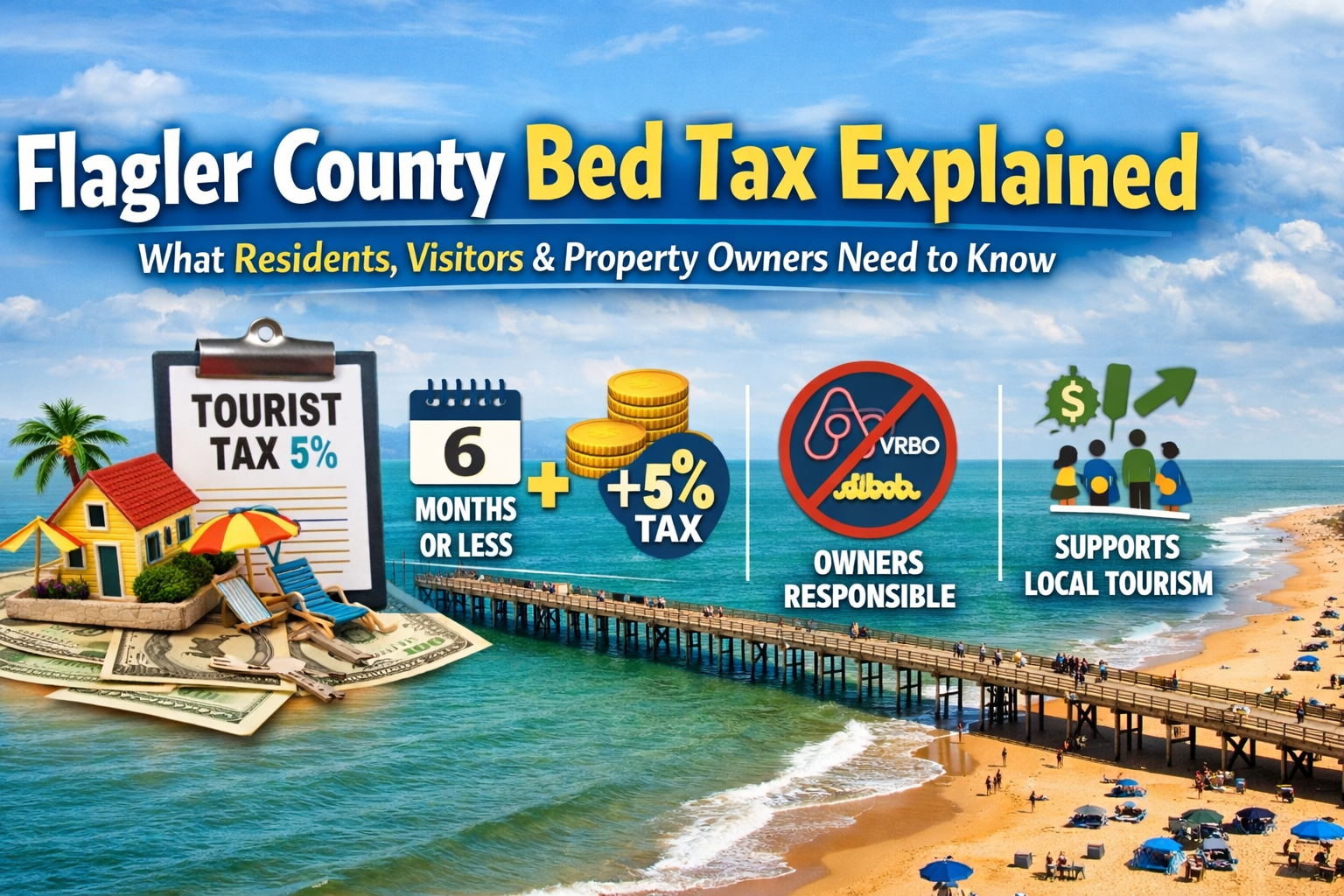
Visitors who stay in hotels, vacation rentals and other short-term accommodations in Flagler County pay an additional local tax known as the Tourist Development Tax — often called the bed tax. Flagler County currently levies the tax at 5%.
What Is Flagler County's Bed Tax?
It is a 5% local Tourist Development Tax charged on qualifying short-term accommodations in Flagler County. The tax is separate from Florida sales tax and the revenue is restricted to tourism-related uses allowed by Florida law and Flagler County's Tourist Development Plan.
6 Months
Short-term rental threshold
60%
Tourism promotion FY2026
40%
Beach restoration FY2026
What Is the Flagler County Tourist Development Tax?
The Tourist Development Tax, or TDT, is a local tax charged on qualifying short-term accommodations in Flagler County.
It is commonly called the bed tax because visitors staying in hotels, motels, vacation rentals and similar accommodations are among those who pay it.
Flagler County currently levies the maximum local Tourist Development Tax rate of 5%.
Who Pays the Flagler County Bed Tax?
The tax generally applies when accommodations are rented or leased for six months or less.
Qualifying accommodations can include:
- Hotels and motels
- Vacation rentals
- Condos and apartments
- Single-family and multi-family homes
- Cottages
- Mobile home and RV parks
- Certain other short-term living accommodations
The guest pays the tax as part of the taxable rental charge, while the person or business responsible for the rental must make sure applicable taxes are properly collected and remitted.
Is the Bed Tax the Same as Florida Sales Tax?
No. The Tourist Development Tax is a local tax in addition to applicable state sales taxes.
That distinction is important for short-term rental operators. Collecting one tax does not necessarily satisfy the requirements for the other.
What Short-Term Rental Charges Are Taxable?
The Tourist Development Tax applies to the taxable rental amount. Mandatory charges associated with renting the accommodation can generally be part of that taxable amount.
Common Taxable Charges
- Rental rate
- Mandatory cleaning fees
- Mandatory pet fees
- Required service or traveler fees
Charges That May Not Be Taxable
- Refundable damage deposits
- Optional travel insurance
Tax situations can vary. Rental operators should confirm current requirements with the Flagler County Tax Collector and Florida Department of Revenue.
Where Does Flagler County's Bed Tax Money Go?
Tourist Development Tax revenue cannot simply be spent like ordinary county revenue. Its use is governed by Florida law and Flagler County's Tourist Development Plan.
Historically, Flagler County divided its five tourist-tax "pennies" among three categories:
- 60% — Promotion & Advertising
- 20% — Beach Restoration & Maintenance
- 20% — Capital Projects
The Allocation Changed for Fiscal Year 2026
For FY2025-26, Flagler County temporarily redirected the 20% Capital Projects allocation to Beach Restoration & Maintenance.
That makes the FY2026 distribution 60% Promotion & Advertising, 40% Beach Restoration & Maintenance and 0% Capital Projects.
Why Is More Bed Tax Money Going to Flagler County Beaches?
Flagler County has been working on a broader strategy to fund beach management, restoration and renourishment.
For FY2026, county officials chose to temporarily redirect the Tourist Development Tax money normally allocated to capital projects into beach restoration and maintenance.
Under the county's adopted plan, the temporary shift applies for FY2025-26. The allocation is scheduled to return to its previous distribution beginning October 1, 2026, unless additional action changes the plan.
Why Should Flagler County Residents Care About the Bed Tax?
Although visitors are generally the people paying the tax, decisions about how that revenue is spent can affect projects and services throughout Flagler County.
Tourist-tax revenue helps support destination marketing and can fund eligible beach restoration, maintenance and other tourism-related uses.
That makes the Tourist Development Tax part of a larger local conversation about tourism, the economy, beaches and how the county pays for projects connected to visitors and the coastline.
What Does the Tourist Development Council Do?
Flagler County's Tourist Development Council, or TDC, reviews tourism issues and makes recommendations to the Board of County Commissioners regarding expenditures of Tourist Development Tax revenue.
The TDC has nine members representing county government, municipalities, businesses that collect the tax and members of the tourism industry.
Final county decisions involving the Tourist Development Plan and use of the tax are made through the applicable county approval process.
What Should Flagler County Short-Term Rental Owners Know?
If you rent property for short-term stays, don't assume the booking process automatically handles every local tax requirement for you.
Property owners and operators should verify how the Tourist Development Tax is being collected and remitted and make sure required returns are filed.
The tax is generally reported monthly. Owners should use the current Flagler County Tax Collector requirements when registering, filing and paying the tax.
People Also Ask About Flagler County's Bed Tax
How much is the Flagler County Tourist Development Tax?
Flagler County currently levies a 5% Tourist Development Tax on qualifying short-term accommodations.
Is the Tourist Development Tax the same as the bed tax?
Yes. "Bed tax" is a common name for the Tourist Development Tax charged on qualifying short-term accommodations.
Does the bed tax apply to vacation rentals?
Yes. Qualifying short-term vacation rentals are among the accommodations subject to Flagler County's Tourist Development Tax.
Does the bed tax pay for Flagler County beach projects?
Yes. Beach restoration and maintenance are among the authorized uses of Flagler County Tourist Development Tax revenue. For FY2025-26, 40% of the county's TDT revenue is allocated to Beach Restoration & Maintenance.
Will the 40% beach allocation continue after 2026?
Under the county's current plan, the FY2025-26 allocation is temporary. Beginning October 1, 2026, the distribution is scheduled to return to 60% Promotion & Advertising, 20% Beach Restoration & Maintenance and 20% Capital Projects, unless the county takes additional action.
The Bottom Line
Flagler County's "bed tax" is a 5% local tax on qualifying short-term accommodations. Visitors generally pay it, but the revenue plays a role in local tourism promotion and beach funding — which is why how the money is collected and spent matters to residents, visitors and rental-property owners.
Sources: Flagler County Government, Flagler County Tourist Development Council and Flagler County Tax Collector. Tax rates, allocations and filing requirements may change. Property owners should confirm current requirements with the appropriate agency.