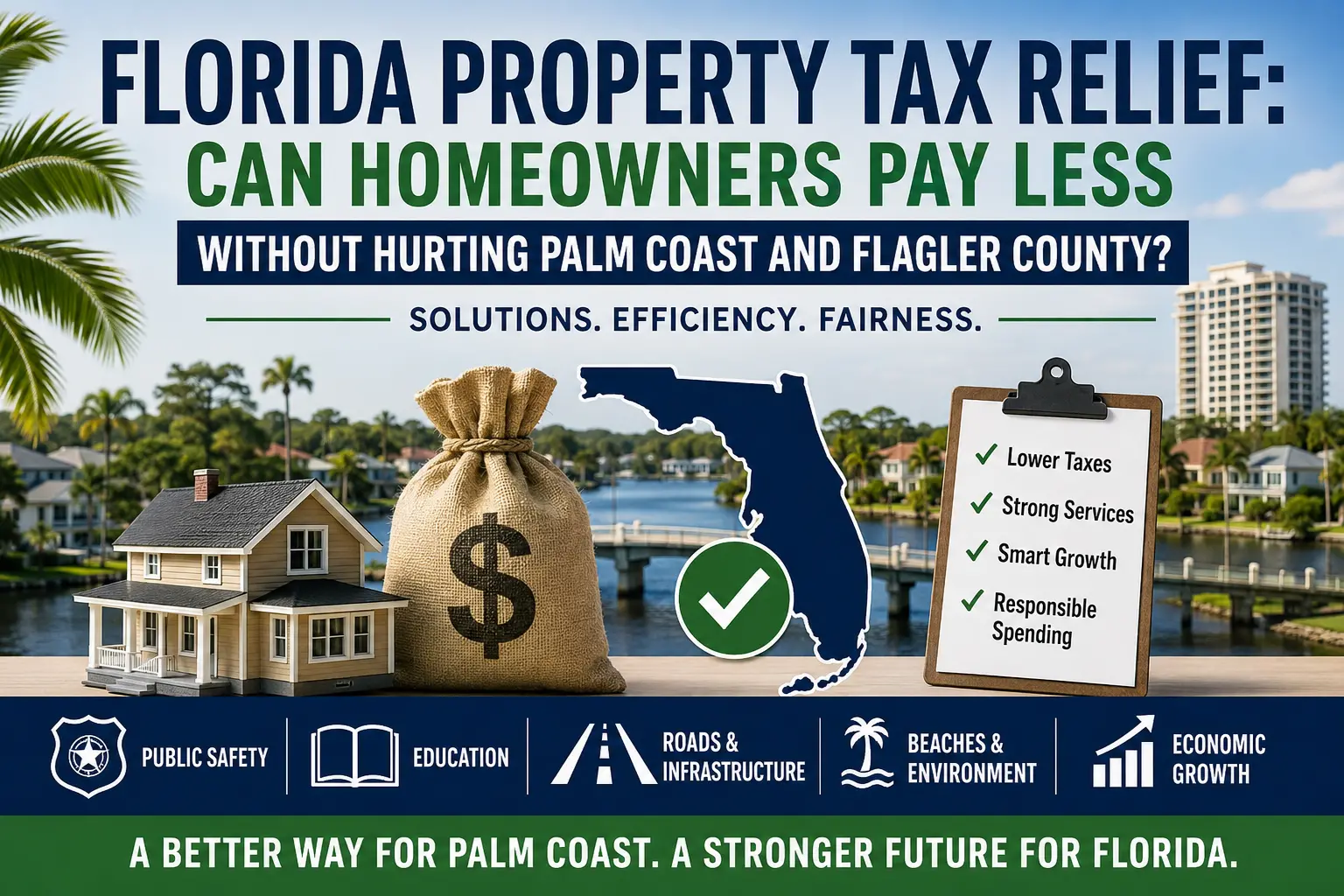
Property Tax Relief Is Possible. But Florida Needs a Plan, Not Just a Promise.
Florida homeowners have watched their property tax bills climb for years as home values have increased. Many families, retirees, and first-time homeowners are asking the same question:
"Why am I paying more every year for the same home?"
Governor Ron DeSantis has placed property tax relief at the center of the statewide conversation, and many Floridians welcome the idea. At the same time, county commissions, city governments, school districts, and local Republican and Democratic leaders alike are warning that reducing property tax revenue without a replacement source could create significant budget shortfalls for essential local services.
Both concerns are legitimate.
The question should not simply be whether property taxes should be reduced.
The real question is:
How can Florida reduce the burden on homeowners while protecting police, firefighters, roads, schools, and local services?
We Need Solutions, Not Just Warnings
Much of the public discussion has focused on how much money local governments could lose.
That is an important part of the conversation.
However, taxpayers also deserve to hear ideas about how governments can operate more efficiently, embrace new technology, and develop new revenue sources before asking homeowners to continue paying higher taxes year after year.
Florida is entering a new era. Artificial intelligence, automation, digital government, and economic growth are changing what is possible.
Instead of assuming every service must cost more each year, perhaps it is time to ask whether government itself can evolve.
Modern Government Can Cost Less
Palm Coast has already demonstrated that online permitting can reduce paperwork and improve efficiency.
Artificial intelligence has the potential to assist with many routine government functions, including:
answering citizen questions 24 hours a day,
processing permit applications,
reviewing forms for completeness,
preparing reports,
routing service requests,
assisting customer service staff.
This is not about replacing public employees overnight.
It is about allowing government to serve a growing population without continually adding administrative positions.
Education Is Changing
Artificial intelligence is rapidly becoming a powerful educational tool.
Many students already use AI to receive individualized explanations, practice difficult subjects, and learn at their own pace.
Teachers remain essential, but technology may allow classrooms to become more efficient while improving learning outcomes over time.
Those long-term changes could eventually influence staffing models and educational costs, although any changes would need to protect educational quality and student development.
Build Smarter, Not Just Bigger
Every major storm seems to bring another expensive dune restoration project.
Rather than repeating the same repairs indefinitely, Florida should continue evaluating whether longer-term engineering solutions, including successful approaches used by other coastal communities where appropriate, could reduce future maintenance costs.
The goal should be resilience, not repetition.
Growth Should Help Pay for Growth
Palm Coast continues to grow.
New subdivisions require roads, utilities, emergency services, and infrastructure.
Impact fees already help fund some of these costs, but policymakers could also examine whether developers should bear additional responsibility for repairing or maintaining infrastructure associated with new developments for a defined period after construction.
Growth should help pay for the demands it creates.
Expand the Commercial Tax Base
Palm Coast's future maybe other commercial developments represent an important opportunity.
Commercial properties generally contribute significantly to local tax revenues while creating jobs and supporting the local economy.
Economic development should be viewed as part of the long-term property tax solution.
A broader commercial base reduces pressure on homeowners.
Reward Long-Term Florida Residents
Rather than providing identical benefits immediately to every homeowner, Florida could consider rewarding long-term residency.
Ideas worthy of discussion include:
enhanced tax relief after a defined number of years in a Florida homestead,
additional protections for seniors living on fixed incomes,
freezing taxable value for qualifying long-term senior homeowners,
phased reductions for homeowners who have spent decades investing in their communities.
These are policy concepts that would require careful legal and fiscal review, but they reflect a principle many Floridians support: rewarding those who have built their lives in Florida.
Diversify Local Revenue
Property taxes do not have to shoulder the entire burden of local government.
Florida could examine additional revenue sources such as:
reasonable business licensing where appropriate,
user fees for services such as garbage collection where communities choose that model,
continued expansion of commercial development,
efficiencies created through technology,
careful review of spending priorities.
No single solution replaces property taxes overnight.
Several smaller solutions together may accomplish far more than one large tax.
Every Dollar Should Be Examined
Taxpayers have every right to expect transparency.
Large capital purchases, technology projects, and infrastructure spending should always be clearly explained and publicly justified.
When governments demonstrate that every dollar has been carefully evaluated, public confidence grows regardless of political affiliation.
This Is Florida's Opportunity
Florida has an opportunity to rethink how local government is funded.
Instead of framing the discussion as a choice between high taxes or reduced services, perhaps the better question is this:
How do we build a more efficient government that delivers the same or better services at a lower cost?
That conversation will require homeowners, businesses, educators, local officials, engineers, technology experts, and community leaders to work together.
Property tax relief and responsible government do not have to be opposing ideas.
With thoughtful planning, innovation, and a willingness to modernize, Florida may be able to achieve both.