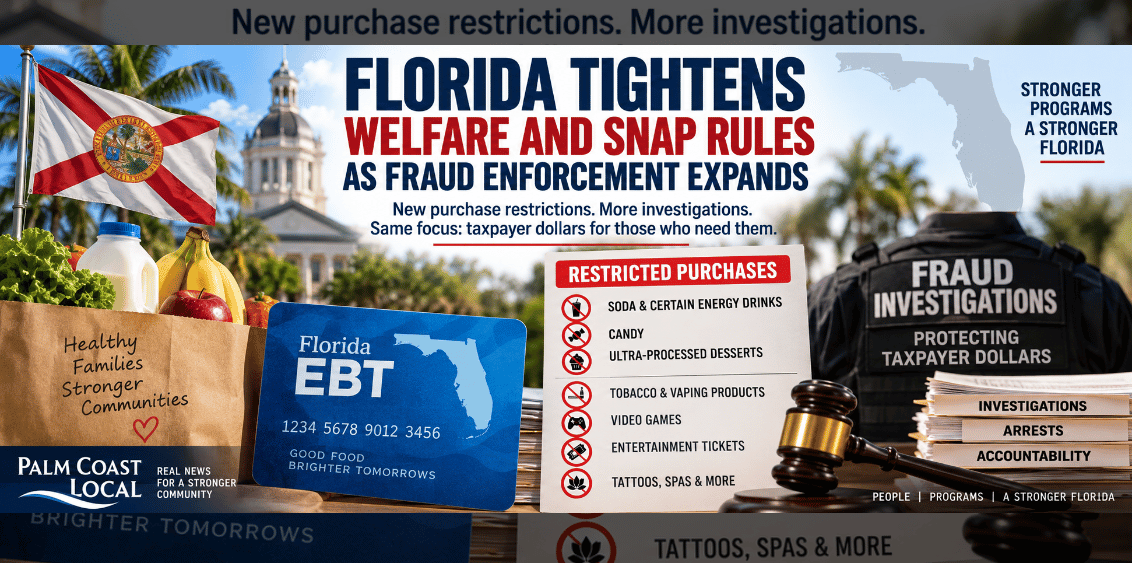
Florida Tightens Welfare and SNAP Rules as Fraud Enforcement Expands
Florida is tightening rules surrounding taxpayer-funded assistance programs while expanding enforcement against public-assistance fraud. New restrictions announced by Gov. Ron DeSantis limit how Temporary Cash Assistance can be spent, while Florida's Healthy SNAP rules already prohibit SNAP benefits from purchasing certain foods. Separately, state investigators continue pursuing cases involving people accused of fraudulently obtaining public assistance, and a new federal-state Florida Anti-Fraud Task Force is increasing cooperation between agencies investigating fraud involving government benefit programs.
Florida is putting new restrictions on how some public-assistance benefits can be used while stepping up investigations into people accused of fraudulently obtaining taxpayer-funded benefits.
The changes don't mean Florida is eliminating SNAP or Temporary Cash Assistance for eligible families. Instead, several separate initiatives are changing what certain benefits can purchase, how assistance programs are monitored and how suspected fraud is investigated.
For Florida residents who receive assistance legitimately, understanding the difference is important.
Florida Restricts How Temporary Cash Assistance Can Be Spent
On August 24, 2026, Gov. Ron DeSantis announced that Florida would amend its Temporary Assistance for Needy Families State Plan to prohibit Temporary Cash Assistance, commonly called TCA, from being used directly to purchase certain luxury, inappropriate or non-essential products and services.
According to the Governor's Office, prohibited purchases will include:
- Tobacco, nicotine and vaping products
- Drugs and intoxicants
- Pornography
- Video games
- Entertainment tickets
- Theme park admission
- Entertainment subscriptions
- Tattoos
- Spa and tanning services
- Psychic and fortune-telling services
Florida already prohibited EBT transactions involving alcohol and at locations such as casinos, gambling facilities and adult-entertainment establishments.
The state says the expanded restrictions will be implemented in phases, beginning with SNAP-authorized retailers and eventually expanding transaction-level controls to additional prohibited products and services.
This Is Temporary Cash Assistance — Not the Same Thing as SNAP
One point that can easily become confusing is that TCA and SNAP are separate assistance programs, even though benefits can be accessed through an EBT card.
Temporary Cash Assistance is intended to help eligible families with basic expenses such as housing, utilities, clothing, household goods and personal-care needs.
The Governor's Office says the average household receiving TCA receives approximately $250 per month.
SNAP — the Supplemental Nutrition Assistance Program — is specifically intended to help eligible households purchase food.
Florida has made separate changes to that program.
Florida's Healthy SNAP Rules Are Already in Effect
Beginning April 20, 2026, Florida SNAP benefits could no longer be used to purchase several categories of food and beverages that the state determined offer little or no nutritional value.
Those include:
- Soda, including regular, diet and zero-sugar varieties
- Certain energy drinks
- Candy
- Ultra-processed shelf-stable prepared desserts
The change did not reduce the amount of SNAP benefits a qualifying household receives.
Recipients can continue using SNAP for eligible foods including fruits, vegetables, meat, dairy products, grains and other grocery staples.
Florida says restricted products are automatically blocked at checkout when a customer attempts to purchase them using SNAP benefits.
Florida Is Also Increasing Public-Assistance Fraud Enforcement
The purchase restrictions are only one part of a broader effort involving Florida's public-assistance programs.
The Florida Department of Financial Services investigates suspected public-assistance fraud, including cases involving SNAP and other benefits.
In May 2026, investigators reported 12 arrests involving approximately $487,728 in allegedly fraudulently obtained public assistance.
Another 48 cases involving approximately $318,895 resulted in administrative action. According to the department, those individuals were disqualified from receiving SNAP for 12 months, 24 months or permanently depending on previous violations.
The enforcement continued during the summer.
In July, the Bureau of Public Assistance Fraud reported seven arrests involving approximately $190,183 in allegedly fraudulently obtained benefits. Another 10 cases totaling approximately $205,059 were presented for criminal prosecution, while 27 cases were referred for administrative action.
What Is Considered Public-Assistance Fraud?
Public-assistance fraud is different from simply using benefits to purchase something that is prohibited.
Florida law authorizes the Department of Financial Services to investigate public assistance provided by the state, including examining electronic benefit transfer records and other records for possible irregularities.
Fraud cases can involve circumstances such as intentionally providing false information to qualify for assistance, concealing income or other information affecting eligibility, or improperly obtaining or using benefits.
In other words, Florida's current effort involves two different issues:
Benefit restrictions determine what legitimately issued assistance can purchase.
Fraud enforcement deals with whether someone intentionally obtained or used public assistance unlawfully.
A New Florida Anti-Fraud Task Force
Florida's enforcement efforts are also expanding beyond individual state agencies.
On September 10, 2026, Florida's three U.S. Attorneys and Florida Attorney General James Uthmeier held the inaugural meeting of the Florida Anti-Fraud Task Force in Miami.
The federal-state task force was created to increase cooperation among agencies detecting, investigating and prosecuting fraud involving federal government benefit programs in Florida.
The significance is largely information sharing.
Government assistance programs are often funded federally but administered partly through state agencies. Increased cooperation gives investigators greater ability to compare information and identify suspicious activity across different programs.
What Does This Mean for Florida Residents?
For people legitimately receiving SNAP or Temporary Cash Assistance, these developments do not mean Florida has ended those programs or broadly reduced everyone's benefits.
Instead, residents should expect tighter controls over what certain benefits can purchase and increased scrutiny of eligibility and suspected fraud.
For SNAP recipients, the most noticeable change has already occurred at grocery-store checkouts, where restricted food and beverage purchases are automatically declined when SNAP is used.
For Temporary Cash Assistance recipients, Florida is now expanding similar controls to prevent taxpayer-funded cash assistance from being used for certain entertainment, luxury and other prohibited purchases.
Meanwhile, the creation of the Florida Anti-Fraud Task Force indicates that enforcement and information sharing between state and federal agencies are likely to remain a priority.
Frequently Asked Questions
Is Florida eliminating SNAP benefits?
No. Florida continues to participate in SNAP. The Healthy SNAP changes restrict certain purchases but do not eliminate the program or reduce a recipient's benefit amount solely because of the food restrictions.
Did Florida reduce SNAP benefit amounts?
No. Florida's Department of Children and Families specifically states that the Healthy SNAP purchasing restrictions do not change the amount of benefits recipients receive.
What foods can no longer be purchased with SNAP in Florida?
Since April 20, 2026, Florida SNAP benefits cannot be used to purchase soda, certain energy drinks, candy and ultra-processed shelf-stable prepared desserts.
Can SNAP still be used for meat, vegetables and dairy products?
Yes. Eligible staples including fruits, vegetables, grains, meat and dairy products remain available for purchase with SNAP benefits.
Are SNAP and Temporary Cash Assistance the same thing?
No. SNAP is primarily a food-assistance program. Temporary Cash Assistance provides eligible families with cash assistance for basic household needs.
What purchases are being restricted under Temporary Cash Assistance?
Florida's newly announced restrictions include products and services such as tobacco and vaping products, drugs and intoxicants, video games, entertainment tickets and subscriptions, theme park admission, tattoos, spa and tanning services and psychic services.
Is Florida arresting people for welfare fraud?
Yes. Florida's Department of Financial Services regularly investigates suspected public-assistance fraud. Cases can result in criminal charges or administrative penalties, including temporary or permanent SNAP disqualification.
What is the Florida Anti-Fraud Task Force?
It is a new federal-state partnership formed to improve coordination in detecting, investigating and prosecuting fraud involving federal government benefit programs in Florida. Its inaugural meeting was held September 10, 2026.